

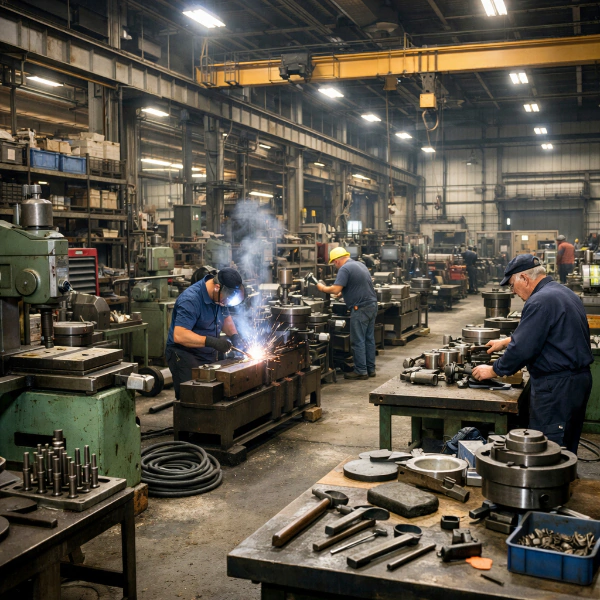
Factory work is built on systems.
In places like Fleckney, where manufacturing and production environments are a core part of local employment, those systems are expected to control risk before it leads to harm. Machinery is guarded, processes are structured, and responsibilities are defined.
When an injury happens, it is rarely because risk was unknown.
It is usually because a control failed at some point in the process.
Understanding how factory floor injuries occur means looking at what happened before the incident, not just the moment itself.
What factory environments are designed to prevent
Factory settings are not designed to eliminate all risk, but they are designed to manage it.
Most sites in Fleckney rely on a combination of:
- Defined working zones that separate people from machinery
- Guards and barriers that reduce direct exposure to hazards
- Routine checks before equipment is used
- Training that links specific tasks to specific procedures
- Maintenance schedules to ensure machinery remains safe to operate
- Supervisory oversight to monitor how work is carried out
When these systems are followed properly, a severe risk of injury is significantly reduced.
When they are bypassed or allowed to break down, incidents become far more likely.
A realistic Fleckney factory scenario
A worker begins a routine shift on a factory floor in Fleckney.
The machinery they are assigned to operate is familiar. The process has been carried out many times without issue.
Earlier in the day, maintenance work was carried out on that machine. To complete the task, a safety guard was removed.
The maintenance work finished. The machine was returned to use.
The guard was not put back in place.
The worker starts the task as normal.
During operation, they come into contact with an exposed part of the machine and are injured.
At first glance, this may appear to be a simple accident.
In reality, it is the result of a sequence.
Understanding the sequence of failure
To assess what happened, the situation needs to be broken down in order.
Before the task began, a change was made to the machinery. That change introduced a new level of risk. The absence of the guard increased exposure to moving parts.
That change was not properly managed.
There was no restriction placed on the use of the machine. No clear communication to the worker. No confirmation that safety checks had been completed before operation resumed.
During the task, the worker operated the machinery as they normally would.
They relied on the expectation that the system around them was functioning as intended.
At the point of incident, the absence of the guard became critical.
After the incident, attention turned to how the situation had been allowed to develop.
This sequence is central to how liability is assessed.
Where responsibility typically sits in factory injury cases
Factory environments operate with defined roles and responsibilities.
In Fleckney, responsibility in an injury case may involve multiple parties depending on how the failure occurred.
This can include:
- The employer responsible for maintaining safe working conditions
- Supervisors who oversee daily operations and enforce procedures
- Maintenance teams who alter or repair equipment
- Individuals who authorise machinery to be returned to use
The key issue is not simply who was present.
It is who had control over the condition that created the risk.
Early-stage failures that lead to injury
When factory accidents are reviewed, certain patterns appear consistently.
These are not isolated mistakes. They are breakdowns in process.
Common failure points include:
- Equipment being used before safety checks are completed
- Temporary changes not being reversed after maintenance
- Poor communication between teams during shift changes
- Workers continuing tasks without being updated on altered conditions
- Production pressure leading to decisions that prioritise output over safety
- Lack of clear responsibility for confirming equipment is safe to use
These issues often develop quietly.
By the time an injury occurs, the failure has already happened.
Why factory injury claims can be strong
Factory injury claims tend to be more structured than other types of workplace claims.
This is because:
- Safety procedures are usually documented
- Roles and responsibilities are clearly defined
- Equipment changes should be recorded
- Risk assessments are expected to exist
When these systems are missing or not followed, it becomes easier to demonstrate that the injury was preventable.
Legal teams such as Marley Solicitors often focus on identifying where the process failed rather than relying only on the injury itself.
How claims are assessed over time
As a claim develops, the focus shifts to the sequence of events rather than a single moment.
This includes examining:
- Whether a change introduced new risk
- Whether that change was recognised and managed
- Whether the worker had the information needed to act safely
- Whether the system allowed unsafe conditions to continue
Each stage is considered in order.
This is what builds a clear picture of responsibility.
What to do after a factory floor injury in Fleckney
The immediate response to an incident can affect how clearly the situation can be understood later.
It is important to capture the condition of the environment as it was at the time.
This includes:
- Recording the state of the machinery involved
- Identifying any recent maintenance or alterations
- Confirming whether safety guards or barriers were in place
- Noting who authorised the use of the equipment
- Preserving any communication related to the task
These details help establish the sequence of events that led to the injury.
The role of system control in preventing accidents
Factory safety is not based on individual awareness alone.
It relies on systems that reduce the need for constant judgement.
When those systems are working, risk is managed consistently.
When they are not, responsibility shifts back onto individuals who may not have full visibility of the situation.
This is where problems develop.
In Fleckney, many factory injuries occur not because workers act unpredictably, but because the systems designed to protect them were not functioning as intended.
Factory injuries follow a sequence, not a single mistake
Factory floor injuries in Fleckney are rarely isolated events.
They are the result of a chain of decisions and missed controls.
A change is made.
A check is missed.
A process continues.
By the time the injury occurs, the failure has already taken place.
Understanding that sequence is what allows responsibility to be identified clearly and the situation to be properly assessed.