

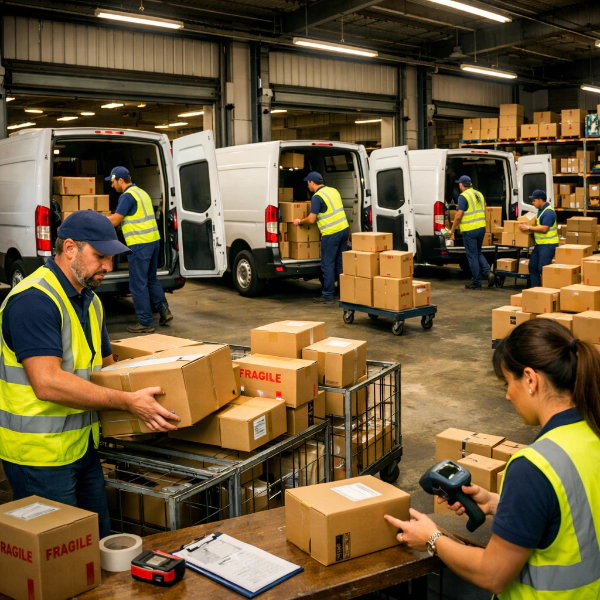
Logistics hubs are built for movement.
In Shepshed, where warehousing and distribution play a crucial role in local employment, we design operations around speed, coordination, and volume. Vehicles arrive and depart continuously. Goods are transferred across teams and shifts. Timing is tightly managed.
That system works when each part operates as expected.
When it does not, failure is widespread.
It moves through the system.
Understanding logistics accidents means looking at how that movement of pressure leads to a breakdown.
Where pressure builds inside logistics environments
Warehousing and distribution are not static.
They rely on targets, schedules, and coordination across multiple roles. In Shepshed, the process often creates a working environment where efficiency is prioritised throughout the day.
Pressure tends to build in specific ways:
- Delivery schedules that leave little room for delay
- Loading bays operating at full capacity
- Continuous handling of goods across different shifts
- Coordination between drivers and warehouse teams under time constraints
None of these factors are unsafe on their own.
The issue is how they influence decisions when something changes.
A realistic Shepshed logistics scenario
A delivery vehicle arrives at a warehouse in Shepshed later than planned.
The delay has a knock-on effect. Another vehicle is already waiting for access to the same loading bay, and the next shift is preparing to begin.
There is pressure to move quickly.
Unloading starts immediately.
The usual checks are shortened. Communication between the driver and warehouse staff is brief. A piece of equipment is used slightly differently to save time, which may lead to increased risks and potential safety hazards during operations.
During the process, an injury occurs.
At first, attention focuses on the moment of the incident.
Upon closer examination, the situation unfolded in a sequence of events.
How system failure develops step by step
The key to understanding logistics accidents is recognising that one issue leads to another.
In this situation:
- A delay creates urgency
- Urgency reduces the time available for checks
- Reduced checks increase exposure to risk
- Communication becomes limited under pressure
- A small deviation from normal procedure goes unchallenged
Each step builds on the last.
By the time the injury occurs, the system has already begun to fail.
We often overlook early-stage breakdown points
When logistics accidents in Shepshed are reviewed, attention often reveals that problems existed before the incident itself.
Common early-stage issues include:
- Schedules that allow no flexibility when delays occur
- Incomplete handovers between shifts
- Overlapping responsibilities between drivers and warehouse staff
- Reduced time for equipment checks during busy periods
- Informal adjustments to procedures becoming accepted practice
- Unclear authority when it comes to stopping unsafe activity
These are not isolated mistakes.
They are signs that the system is under strain, indicating that unclear authority and layered responsibility may contribute to the persistence of unsafe activities.
Where responsibility becomes layered
In logistics environments, responsibility is usually shared.
Multiple roles contribute to how work is carried out.
This may include the company managing the warehouse, supervisors overseeing daily operations, drivers working within delivery schedules, and teams responsible for loading and unloading.
Each of these roles has a level of control.
The key issue is identifying who controlled each part of the process at the point where the breakdown occurred.
Responsibility tends to follow those points of control.
Why these claims are more complex than they appear
Logistics accidents in Shepshed are often more complex than standard workplace incidents.
This is because the system itself plays a role in shaping behaviours.
Decisions are not always made in isolation. They are influenced by time pressure, workload, and coordination between different teams.
As a result:
- Responsibility may shift between stages of the process
- The final action may not reflect the root cause
- Evidence may focus on the incident rather than the sequence leading to it
Without analysing the full chain, it is easy to focus on the wrong points.
Legal teams such as Marley Solicitors often approach these cases by mapping how the situation developed rather than relying solely on what happened at the end.
Late-stage indicators of system failure
As a claim progresses, certain patterns tend to emerge.
These help show whether the system itself contributed to the incident:
- Safety procedures were not followed consistently
- Time pressure influenced how decisions were made
- Deviations from normal process were accepted without review
- Communication between teams was incomplete
- Workers did not feel able to pause or question unsafe conditions
- Efficiency targets took priority over safety controls
These indicators shift the focus away from individual faults and toward system performance.
What steps should be taken after a logistics accident occurs in Shepshed?
Capturing the full sequence is critical.
It is not enough to record the moment of injury. The events leading up to it matter just as much.
Key steps include:
- Recording the timeline before the incident
- Identifying who was involved at each stage
- Noting any delays or disruptions
- Confirming what procedures should have been followed
- Preserving communication between teams where possible
This helps build a clearer picture of how the situation developed.
Why pressure-driven environments increase risk
Logistics hubs are designed to handle volume.
The more efficient the system becomes, the less margin there is for disruption.
When something does go wrong, the system does not always slow down.
Instead, it adapts.
That adaptation can involve cutting time from checks, simplifying communication, or adjusting procedures in ways that increase risk.
In Shepshed, this pattern is a common factor in accident cases.
Accidents follow the system, not just the action
Logistics hub accidents are usually caused by multiple mistakes.
They develop through a chain of events.
A delay leads to urgency.
Urgency reduces control.
Reduced control increases risk.
By the time the injury occurs, the system has already broken down.
Understanding that sequence is what makes it possible to identify where responsibility actually sits, rather than focusing only on the final moment of the incident.