

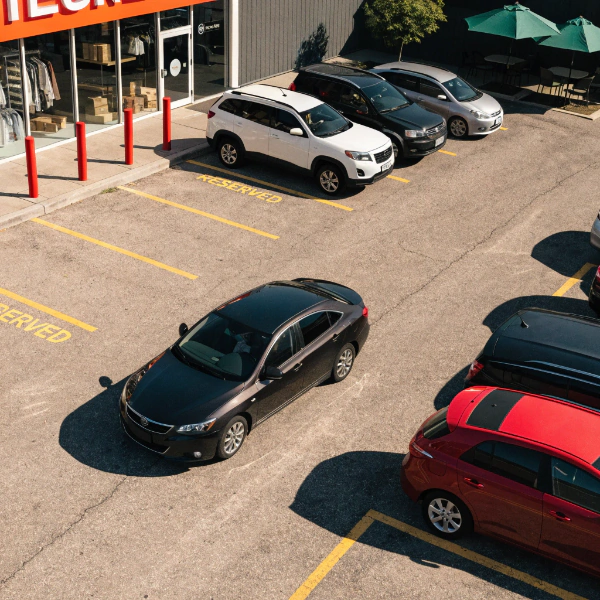
Retail environments change how accidents happen.
In areas like Birstall, particularly around busy retail parks, traffic rarely behaves in a predictable way. Vehicles stop without warning, pedestrians move between parked cars, and drivers split their attention between navigation and parking.
This creates a type of accident that does not follow the usual “rear-end equals fault” or “reversing driver is responsible” assumptions.
In reality, liability in these situations is often more complex.
Why retail zones increase collision risk
Unlike standard road layouts, retail zones combine multiple behaviours in one confined space.
Drivers are not simply travelling from A to B. They are:
- Looking for parking spaces
- Watching for pedestrians crossing informally
- Reacting to vehicles reversing
- Navigating tight lanes with restricted visibility
In Birstall, the issue is especially noticeable around high-traffic shopping areas where vehicle flow changes constantly throughout the day.
As a result, accidents tend to involve:
- Low-speed impacts
- Reversing collisions
- Pedestrian contact
- Side-swipes in narrow lanes
These are not always straightforward to assess.
How fault is assessed in retail zone accidents
Liability is not automatically based on who made contact first.
Instead, claims are typically assessed based on driver behaviour in the environment.
Key considerations include:
- Whether speed was appropriate for the setting
- Whether the driver maintained proper observation
- Whether another road user created a hazard
- Whether the layout contributed to the incident
For example, driving at 15–20 mph may be acceptable on a normal road, but excessive within a crowded retail park.
This distinction is where many disputes arise.
A realistic Birstall scenario
A driver begins reversing out of a parking space.
At the same time, another vehicle travels through the lane behind them at a steady speed.
A collision occurs.
Initially, it may seem that the reversing driver is at fault. However, if the moving vehicle failed to slow down in a congested area or ignored visible hazards, liability may not be one-sided.
In some cases, responsibility is shared.
This scenario is where claims become more technical.
Factors that commonly affect liability decisions
Retail zone accidents often involve multiple contributing behaviours rather than a single mistake.
Late-stage assessments usually consider:
- Speed relative to congestion
- Visibility blocked by parked vehicles
- Reaction time and awareness
- Pedestrian presence
- Overall layout of the car park or retail space
These factors are used to determine whether a driver acted reasonably under the circumstances.
Why proving fault can be difficult
In many retail accidents, physical damage alone does not explain what happened.
Without supporting evidence, claims can:
- Be reduced due to split liability
- Be delayed while fault is disputed
- Fail if responsibility cannot be clearly demonstrated
This situation is particularly common in low-speed incidents where there is limited impact damage.
Legal teams, including firms like Marley Solicitors, often focus on reconstructing behaviour rather than relying solely on vehicle damage.
When fault assumptions change
Initial conclusions about fault are not always accurate.
They can shift after further review, particularly where:
- A driver failed to anticipate pedestrian movement
- A vehicle entered a lane without proper observation
- Another driver was travelling too quickly for the environment
- Visibility was significantly restricted
Retail environments introduce variables that are not present in standard road collisions.
What to do immediately after an accident in Birstall
The steps taken at the scene can directly affect the outcome of a claim.
It is important to:
- Take clear photos showing vehicle positions and surroundings
- Capture any visibility restrictions (parked cars, signage, obstructions)
- Speak to witnesses, including pedestrians
- Avoid making assumptions about fault at the scene
This type of evidence often becomes critical later.
Why retail accident claims require careful handling
These claims are rarely about a single mistake.
They are about understanding how multiple actions contributed to the incident.
Without proper analysis, a claim may be undervalued or incorrectly assessed.
This is why early evidence and structured evaluation matter.
Fault is rarely obvious in retail zone accidents
The environment influences road traffic accidents in Birstall retail zones as much as driver behaviour.
Assuming fault too early can lead to the wrong conclusion.
Examining the development of the situation, rather than just the collision, builds the strongest claims.
Understanding that difference is what separates a straightforward claim from a disputed one.