

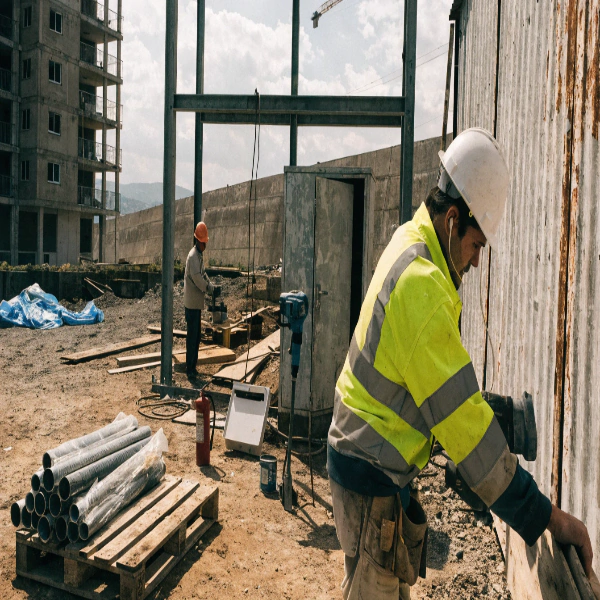
Construction sites are not risk free. They are supposed to be controlled.
That difference matters, because most injuries in places like Blaby do not come from unpredictable events. They come from situations that were allowed to develop over time until something went wrong.
- A missing guardrail
- A rushed job.
- A decision to carry on when something was not quite right.
By the time someone gets injured, the problem has usually been there for a while.
- Where things actually go wrong on site
If you step back and look at patterns, accidents tend to happen in the same types of situations.
Not because construction is chaotic, but because certain tasks rely heavily on discipline. When that discipline drops, risk increases quickly.
Typical problem areas include:
- Work at height where edge protection is incomplete or removed
- Scaffolding that has been altered after installation
- Machinery operating too close to workers on foot
- Temporary walkways that were never designed for constant use
- Materials stored in ways that restrict safe movement
None of these are unusual. They are situations that should have been controlled properly.
- What cutting corners looks like in real life
It is often unclear.
No one stands up and says safety is being ignored. Safety issues manifest in small decisions that accumulate over time.
A site in Blaby is experiencing delays. One trade finishes late, which delays the next. Once access is finally granted, the urgency to act swiftly intensifies.
- The guardrails have not been put back yet.
- The job needs to be done.
- The work starts anyway.
That is how most of these situations begin.
The situation doesn’t arise from blatant negligence, but rather from compromise.
- Responsibility is rarely as simple as one party
It is common to assume that if someone is injured, the employer is automatically responsible.
Occasionally that is true. Often it is more complicated.
A typical construction site involves multiple layers:
- A main contractor managing the project
- Subcontractors carrying out specific work
- Someone responsible for enforcing safety procedures
- A developer or site owner setting expectations
When something goes wrong, the key question is:
Who had control over the risk at that point?
It might be the person giving instructions.
It might be the company that failed to provide equipment.
It might involve more than one party.
At this point, the claims process becomes more technical.
- A realistic Blaby scenario
A worker is asked to carry materials across part of a site where the ground has changed. It is uneven, with loose debris underfoot.
No proper walkway is established.
No one raises it as a concern.
It is treated as manageable.
While carrying weight, the worker slips and falls.
Now look at it properly:
- Was the condition of the ground known?
- Should access have been restricted or improved?
- Was the task appropriate given the conditions?
The injury is only the result. The important part is what led up to it.
- Why evidence matters more than people expect
Many people assume the injury itself is enough.
It is not.
Without context, it is just an incident. To show liability, you need to show that something should have been done differently.
That usually comes down to:
- What the site looked like at the time
- Who was responsible for safety
- Whether risks had already been identified
- What instructions were given before the incident
If this is not captured early, it becomes much harder to prove later.
This is why firms such as Marley Solicitors focus on understanding how the situation developed, not just the injury itself.
- Where claims start to weaken
There are common points where claims lose strength:
- The incident is not formally reported straight away
- No photos are taken, so conditions cannot be shown
- Responsibility is unclear between different contractors
- The injured person is assumed to be at fault without proper review
These issues do not automatically stop a claim, but they make it harder to challenge a defence.
Typically, a defence will be present in these cases.
- What to do immediately after an injury
You do not need to overcomplicate this, but timing matters.
Focus on:
- Making sure the incident is officially recorded
- Capturing the area as it actually is
- Getting details from anyone who saw what happened
- Keeping any messages or instructions related to the task
The objective is not to construct a case immediately.
The goal is to ensure that the reality of the situation remains intact.
Closing perspective: The risk was already there
Construction injuries in Blaby rarely occur unexpectedly.
They are usually the result of a chain of decisions.
- A missed check.
- An ignored hazard.
- A choice to carry on anyway.
If you only look at the moment of the accident, you miss the real issue.
The stronger approach is to look at where control broke down and why it was allowed to happen.
That is where responsibility sits.