

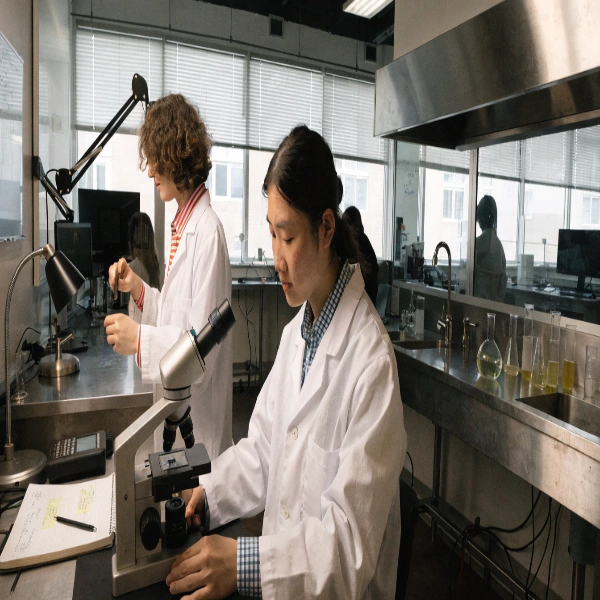
Laboratories are designed to be controlled environments.
In Loughborough, where university labs support both teaching and advanced research, that control is expected to extend across procedures, equipment, and supervision. When an accident happens in that setting, it raises a different type of question compared to other workplace incidents.
Not just what went wrong, but how a controlled system allowed it to happen.
Understanding responsibility in lab accidents requires looking beyond the moment of injury and examining how the environment was managed.
Why lab environments are more complex than they appear
On the surface, university labs seem structured.
There are procedures to follow, equipment is assigned for specific tasks, and access is often restricted. This creates the impression that risk is tightly controlled.
In practice, the environment is more layered.
In Loughborough labs, it is common for:
- Students at different experience levels to use the same space
- Researchers to adapt procedures depending on their work
- Equipment to be shared across multiple projects
- Supervision levels to vary depending on the time of day or activity
This combination creates a situation where responsibility is not always concentrated in one place.
Instead, it is distributed across multiple roles.
A realistic Loughborough lab scenario
A student is carrying out a practical task in a university lab in Loughborough.
The procedure is familiar, but on this occasion, the setup has been adjusted slightly to accommodate a different approach. The change is not formally documented, but it is considered manageable.
The student proceeds with the task.
During the process, something goes wrong. The student is injured.
There is no immediate, obvious cause.
At first, it appears to be an isolated incident.
Looking beyond the immediate cause
To understand what happened, the focus needs to shift away from the injury itself.
The key issue is how the situation developed.
- Was the procedure changed without proper review?
- Was the equipment set up correctly for that variation?
- Was supervision expected or required at that stage?
- Did the student fully understand the adjusted process?
Each of these questions adds context.
The incident becomes less about a single action and more about how multiple factors came together.
How responsibility is identified in lab accidents
In a university lab setting, responsibility does not sit with one person by default.
Instead, it depends on who controlled different aspects of the process.
This may include:
- The university as the organisation responsible for the facility
- Academic staff who design or oversee the activity
- Lab supervisors responsible for enforcing safety procedures
- Individuals carrying out the work
The challenge is identifying who controlled the conditions that led to the risk.
Responsibility follows control, not just involvement.
What do investigators look at in these cases?
Once the situation is examined in detail, certain areas become important.
These include:
- Whether the procedure being followed was formally approved
- Whether any changes to the process were properly assessed
- Whether the equipment used matched the requirements of the task
- Whether supervision was present when needed
- Whether the individual had the appropriate level of training
- Whether safety instructions were clear and followed
- Whether known risks had been addressed before the task began
These factors are considered together.
Usually, no single point explains the incident on its own.
Why lab accident claims are often complex
Lab accidents in Loughborough often involve overlapping responsibility.
This complexity is because the environment is shared and dynamic.
Procedures may evolve during research. Equipment may be adapted. Supervision may change depending on who is present.
As a result:
- There may be no single clear point of failure
- Documentation may not reflect what actually happened
- Responsibility may be divided across multiple roles
- Small changes can have a significant impact on safety
Without a clear record, it becomes difficult to isolate the exact cause.
Legal teams such as Marley Solicitors often approach these cases by examining each stage of the process to determine where control existed and whether it was exercised properly.
After a lab incident, the situation becomes critical
The strength of a claim often depends on how well the situation is documented.
In a lab setting, small details matter.
It is important to capture the following:
- The exact setup of the equipment at the time
- The version of the procedure being followed
- Any deviations from standard practice
- Who was present and supervising
- Whether any prior issues had been identified
Without this information, it becomes harder to reconstruct the sequence of events.
The role of training and supervision
Training and supervision are central to lab safety.
In Loughborough, students and researchers are expected to follow guidance, but that guidance must be clear and appropriate for the level of experience.
If a task involves risk, there should be:
- Clear instructions on how to carry it out safely
- Access to appropriate equipment
- Supervision where required
- A process for identifying and managing changes
When these elements are not in place, the likelihood of error increases.
Why small changes can lead to significant risk
One of the defining features of lab accidents is how small changes can have a large impact.
- A slight adjustment to a procedure.
- A different configuration of equipment.
- A step that is skipped because it seems unnecessary.
Individually, these may not seem significant.
Together, they can alter the level of risk in a way that is not immediately obvious.
This is why reconstruction of the process is so important.
Control determines responsibility
University lab accidents in Loughborough are not usually the result of a single mistake.
They develop through a combination of decisions, conditions, and oversight.
The key question is not simply what happened.
It is who had control over the situation at each stage and whether that control was used properly.
Understanding that is what allows responsibility to be identified clearly and the situation to be assessed fairly.